

 |
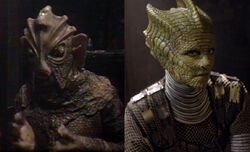
| Before and after L'oreal's new facial cream. |
In 1970, the Third Doctor and UNIT investigate odd power disturbances at a new atomic power plant, where it turns out ancient creatures called Silurians are leaking energy in order to resurrect their frozen ranks and reclaim the Earth in the infuriatingly titled Doctor Who and the Silurians.
In 2010, the Eleventh Doctor, Amy and Rory investigate odd power disturbances at a new drilling site, where it turns out ancient creatures called Homo reptilia are leaking energy in order to prevent their colony from being dug into, and have decided to resurrect their frozen ranks and reclaim the Earth in the kinda stupidly titled "The Hungry Earth"/"Cold Blood".
The differences go far beyond the superficial: in both cases, the elder Silurian leader is one of the few voices of reason, while it's some militant upstarts that decide to mutiny and wipe out us apes. In both cases, we're brought to the brink of war because the Silurians feel entitled and strike first, and the humans see retaliation as the only option. In both cases, hostilities early on breed resentment on both sides that makes brokering peace difficult. In both cases, negotiation sessions come to the conclusion that Silurian tech could benefit Earth and that our lizard brethren would be just fine living in the Sahara. And, perhaps most importantly, both stories end with the Doctor putting the Silurians back in cryogenic freezing to negotiate peace later--though here, there are crucial differences that'll need to be addressed.
While things play out largely the same way both times, it's far easier to see where the humans in the 2010 version are coming from. UNIT ultimately fights the Silurians for reasons of world security, without even trying to negotiate with them, whereas here the Silurians make things personal and emotions get heated. It's a small difference, but it makes the humans much more sympathetic. They're not being bullheaded, they're being vulnerable.
The 2010 version also makes the Silurians much more sympathetic. In Doctor Who and the Silurians, the Elder Leader was sympathetic, but the rest of the Silurians were just straight-up species-ist dickweeds with no redeeming features and no reason to sympathize with them. The addition of the physician helps with that immensely, and even the human-hating Silurians have humanizing characteristics in their familial connections.
And then, of course, there's the ending. Three refreezes the Silurians so that they'll wake up one at a time, and can be reasoned with one-on-one without fear of war breaking out. Eleven pins the blame solely on the humans, and decides to reawaken all of Siluria at once in the future so that humanity has time to get ready. You can debate which approach works better, but ultimately we'll never know--the Brigadier blows up the old Silurians in the end, not trusting Three's insistence that negotiation is possible. (Ultimately, Three forgives him for this surprisingly quickly, but he kinda had to or the premise of his era breaks down. It's a memorable ending, but one that only works if you pretend this serial exists in a vacuum.)
Now, that's not to say Doctor Who and the Silurians is all bad. It does have one major, solid advantage over its successor, which is that the 1970 Silurians are legitimately alien and freaky and slightly unknowable. They don't look like us, they don't sound like us, they have powers we don't. Which makes it very powerful and very meaningful that the Doctor almost immediately accepts them as a sentient race worthy of respect in a way that no one else really does. In "The Hungry Earth"/"Cold Blood", the Silurians are much easier to connect to, with their human faces and normal voices. There's very little of the outsider in there, which makes it seem like the humans that accept them now when they didn't before because they're suddenly palatable.
Neither is bad, per say, but I think the new series is the clear winner this round, with its stronger characterization and more natural flow of storytelling. It also manages to be, despite all the human-bashing, much less cynical than its predecessor, if only because no one here is a complete jerkwad.
Still, I'd check out Doctor Who and the Silurians. It's a good example of the dynamic between the Brigadier and Three (if you ignore the genocide) and worth it for the unique (and kinda silly) Silurian designs of the era. (Seriously. They have lasers in their heads that can rebuild walls. It's great.)
Doctor Who and the Silurians is available on DVD, with a commentary from almost the entire cast plus the showrunners; a documentary on the political climates of the time that shaped the story, a look at the (seriously bombastic and kinda irritating) soundtrack, and a making-of documentary, amongst other neat things.
"The Hungry Earth"/"Cold Blood" is available on DVD with Series 5, with commentaries, a look at the monsters, and other neat things.
And, of course, Ley has her own take on "The Hungry Earth"/"Cold Blood" here.

